
October 29, 2026
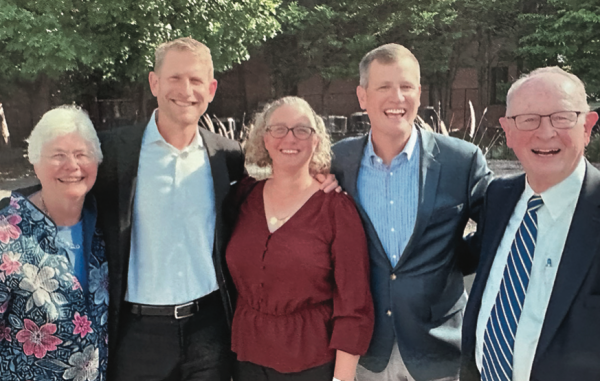
It's close to midnight on Sat., Oct. 25, 1986, and 13-year-old Sam Kennedy is inching toward the edge of the yellow couch in his home at 46 Glen Road in Brookline, watching as the Boston Red Sox inch toward a win against the New York Mets that would give them their first World Series championship in 68 years.
Boston is up, 3-2, in the best-of-seven series, and up, 5-4, in the bottom of the tenth inning of Game Six, one out away from taking the title — when Mookie Wilson steps into the batter's box at Shea Stadium to face Boston relief pitcher Bob Stanley.
What happens next is the stuff of Red Sox legend: a wild pitch, a ball through Bill Buckner's legs at first base, and the Mets' Ray Knight racing home with the winning run.
"When the ball went through Bill Buckner's legs, I was just crestfallen and devastated," Sam said. "But I remembered the feeling of what it was like to make it to the World Series and just thought, 'We're going to get back there, and we're going to have a chance to win it.'"
Even then, all those years ago, the "too positive" Sam Kennedy always saw the glass half full. That instinct — to find the optimism in any situation — would eventually carry him from a Brookline couch to the president and CEO's office at Fenway Park.
Growing Up at Fenway
With an Episcopal clergyman as a father and a teacher as a mother, the Kennedy family was not rich financially, but rather in ways no bank account could ever show. During weekly trips from Glen Road to Trinity Church, where his father Rev. Tom Kennedy served, Sam came to know and love the old ballpark where the Red Sox played.
"Fenway Park kind of sat in between Brookline Village, where we were, and Trinity Church, where my dad worked, and I just sort of fell in love with the park first, even before the Red Sox," he said.
Full of curiosity, Sam made it his mission to spend more time near the ballpark. He and his friends figured out that on game days, police would sometimes pass along tickets they'd taken from scalpers to kids who asked politely. Then came a discovery that changed everything: his father had a clergy pass.
"My dad took me on the clergy pass a bunch, and he then let me use it," said Sam. "I think I stole it out of his wallet and put it in mine. I would go down to Gate D and just get to know the people at the gate. You were just given a standing-room ticket with the clergy pass. We stood in section 25, which is behind third base. Until I went off to college, I probably went to 30 to 40 home games a year."
From Brookline High to the Yankees to the Red Sox
Sam described himself and his teammate and friend Theo Epstein as "two very below average baseball players" at Brookline High. After graduating, he somehow found his way onto the Trinity College baseball team's roster — then cut himself by asking his coach when he should study abroad and taking the hint when the coach suggested spring semester.
His involvement in Major League Baseball, though, was just beginning. Between his freshman and sophomore year at Trinity, he told his father he needed a baseball internship. His father reminded him that those jobs didn't pay, and he had a perfectly good job at Dexter Day Camp.
Sam's reply: "You know, Dad, that's negative thinking."
Next-door neighbor Peter Gammons, the Baseball Hall of Fame sportswriter, offered the advice that launched everything: write to every major league team. Sam did. Then one weekend at Toad's Place in New Haven, Theo Epstein told Sam about a summer internship with the Baltimore Orioles. Sam wanted in.
The New York Yankees called with an interview. Sam was offered a job and moved to New York City after his sophomore year. That 1993 internship — selling airtime for ABC radio's Yankees broadcasts — started everything. He would return to Yankee Stadium the following two summers.
After graduating in Trinity's Class of 1995 with a bachelor's degree in American Studies, he hoped the Yankees would hire him full time. The 1994-95 baseball strike made that unlikely. But they helped him land a job as a salesman at ABC Radio.
The Road to Fenway — via San Diego
Theo Epstein had moved with his boss Larry Lucchino from the Orioles to the San Diego Padres, and persuaded Sam to apply for an in-house marketing position. Sam spent six years with the Padres, starting as an account executive in 1996 and working his way up to executive director of corporate accounts and broadcasting.
By the early 2000s, Boston was calling — in the person of Larry Lucchino, who was partnering with Tom Werner and John Henry to buy the Red Sox. Lucchino invited Theo and Sam to his house and asked them to join him. A contract dispute with the Padres led to a weeks-long campaign — "Free the Brookline Two" — before the pair were finally released.
On March 25, 2002, Theo and Sam began their careers with the Red Sox. Theo quickly took over as general manager. Sam was named vice president of Corporate Partnerships.
Two years later, the Red Sox won their first World Series in 86 years — coming back from three games down to the Yankees in the American League playoffs, then sweeping St. Louis in the World Series.
On Father's Day in 2005, Sam presented Rev. Tom with his World Series ring at Fenway Park. "What seemed like a perfect day got even better when John Henry replaced Sam's and Theo's rings after hearing what they had done," recalled Rev. Tom.
Sam rose to co-founder and president of Fenway Sports Management, then chief operating officer, and finally president and CEO of the Red Sox in 2015, promoted to CEO in 2017.
"The true gift of all of it has been the rare ability to progress within the organization, grow up in the organization," Sam said. "I'm thinking back to 2002, 2003, and 2004, and then when we won the World Series. It reinforced this notion that a positive mindset can literally change the trajectory of a franchise, change the trajectory of a ballpark."
Nana Kennedy's Social Genes
Sam credits much of who he is to his grandmother Roberta Williamson Kennedy — "Nana Kennedy" — the matriarch of the family who was "crafty" and "friends with everybody, always convening people, gathering people.
"Me and my brother and sister did not inherit great genes athletically, but we definitely inherited Nana Kennedy's social genes," he said. "She was an incredibly social person and was sort of the mayor of their town."
His mother, Joanna, put it simply: "He loves people; they love him. I don't remember a day in his life that he didn't have a bunch of friends at our house. His business is connecting people."
On the question of his relentless positivity, Sam is self-aware.
"I am aware enough to know that that does come across sometimes as either disingenuous or being too positive or not being truthful about where things stand," he concedes. "I recognize that, and I acknowledge that, but I don't really care because it's worked very, very well for the Red Sox. It's not about me; it's about the broader organization, and the mindset of our front office is ferociously positive, entrepreneurial, and we all are pulling in the same direction."
Beyond the titles, the team, and the rings, Sam remains a people person and a family man. His favorite times aren't always at Fenway Park — they pop up at fields around New England where he cheers on his daughter Ally on the Middlebury College field hockey team, and on the golf course with his son Jimmy, who graduated from Boston College last spring.
"We all sort of feel like we're on a mission at the Red Sox and within Fenway Sports Group," he said, "and that's something that I hope we never lose."
<Cassidy McNeeley is a staff writer at The Dorchester Reporter and a contributor to Boston Irish's Magazine and website.