
October 29, 2026
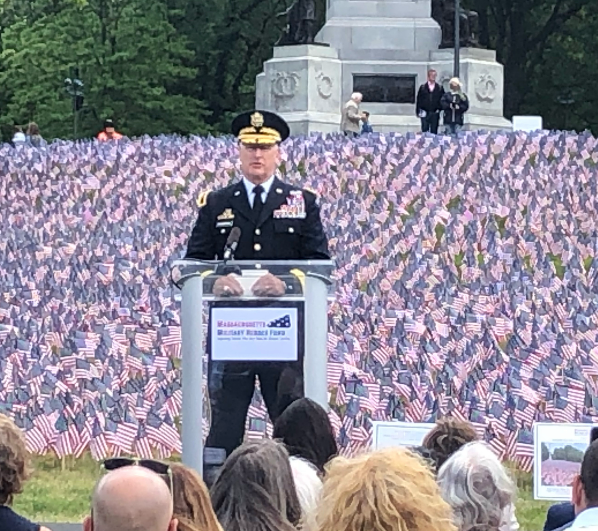
When US Army Brigadier General (Ret.) Jack Hammond enters the Home Base Institute headquarters in Charlestown Navy Yard every morning, ready to advance the mission of treating the "invisible wounds" of war, his hands may be full, but his eyes are scanning the clinic.
In the corridors of the busy outpatient clinic — with more than 200 attendants on staff — his eyes eventually focus on one of the combat veterans waiting in a conference room for treatment or a therapy group. Most of them are there for the Institute's cutting-edge, two-week intensive healing regimen, while others have come for regular appointments.
Taken together, they serve as a daily reminder to Hammond — a general officer who held leadership roles in the field during three tours of duty in Iraq and Afghanistan between 2002 and 2012 — of his own healing journey after his "invisible wounds" nearly turned tragic, and he sought the kind of help that makes him a better leader at Home Base today.
"I had a seminal moment back in 2006 over in Cambridge where I was caught in traffic on a Sunday, and we had just celebrated my daughter's acceptance to Harvard," he recalled. "I was literally sweating and everything else and I just needed to get out of that intersection. In Iraq, that's when somebody threw a grenade in your window or just walked by and unloaded an AK into you. Your anxiety levels go off the chart."
That conversation with his wife, Colleen (Halloran) Hammond, exposed the unresolved traumas from his wartime service — and he began to seriously consider the effects of those traumas and the serious need to address them.
Treating veterans with issues like Gen. Hammond's is what Home Base is all about under his leadership: dedicated space, caring personnel, and advanced-level treatment to address the lingering effects of war on those who did the fighting: Post Traumatic Stress Disorder (PTSD), traumatic brain injury, suicidal ideations, and anxieties that can't be curtailed with pills or serums.
"They're all one bad decision away from something tragic, whether it's taking their own life or hurting somebody else," he said. "I always believe what we do here is we help these men and women reclaim the life they once had, and they deserve."
Irish Roots in County Louth Soil
Resilience runs deep in the Hammond family's Irish heritage. One of the general's four grandparents — his mother's father, Edward Ferguson — was born in 1872 in Co. Louth. He left for America around 1890 and, despite losing his arm in a train coupling accident in the rail yards, went on to graduate from Northeastern University Law School around 1908 and eventually became the attorney for the city of Cambridge.
On the side, he helped a young Tip O'Neill first get elected to the Massachusetts Legislature and then to Congress — a political connection that passed down through the family.
Hammond grew up in Reading, one of five siblings, and graduated from Reading High School playing football, wrestling, and running track. He worked his way through UMass Boston while wrestling and playing lacrosse, earning his spot as a senior walk-on.
A chance encounter with a National Guard recruiter — he had intended to visit the Army Reserves office — changed everything. A coffee mug promising "100% free tuition" at state colleges sealed the deal.
"I don't know why, but the fact that he had a coffee cup with that printed on it, I thought it would be a pretty elaborate ruse to have a fake coffee cup made," Hammond recalled. "And I said, 'I don't care if you're the Salvation Army, I'm in.'"
From Logan Airport to Fallujah
Hammond remained on active duty from 1984 until retiring in 2012. After September 11, 2001, he was deployed within hours of the attacks to help secure airports, including Logan International in Boston, where two of the attacking planes had taken off.
In June 2002, he left for Afghanistan. In three tours of duty, he commanded US and NATO forces in Iraq — mostly in Fallujah — and led counter-terrorism combat operations in Afghanistan, where he faced mass casualty attacks including the 2011 assault on the US Embassy in Kabul.
"I went to bed at night knowing that somebody was going to spend their night trying to figure out how to kill me in the morning," he said. "So, you couldn't just do what you did yesterday. You always had to evolve."
His final assignment, in 2010 and 2011, was as commanding general of US Forces in Kabul Province — responsible for more than 10,000 troops at 11 bases.
From Home Base to Boston Hope
Hammond moved from military retirement to CEO of Home Base Institute in 2012 while seeking help for a military friend. A conversation with co-founder Mike Allard quickly led to an interview — and Allard knew immediately that Hammond could take the organization to the next level.
"Jack is definitely a case study in a great personality," Allard said. "What's great about him is that amongst his peers, we all have egos. Jack doesn't have an ego."
Home Base was the first private sector entity to pursue treatment of invisible wounds as a way to reduce veteran suicide. Under Hammond's leadership, it has developed new programs including a two-week intensive course for veterans from all over the country — 41 cohorts of 12 people per year at no cost to the patient. The organization has also expanded clinic operations to Florida, Texas, and soon, Australia.
The test of a lifetime came in March 2020, when then-Gov. Charlie Baker called Hammond and asked him to build and run a 1,000-bed field hospital for Covid-positive patients at the South Boston Convention Center — in seven days.
Hammond pressed on. The result was the Boston Hope Covid-Positive Field Hospital. They treated 725 patients over three months before closing in June 2020.
"We didn't lose anybody," Hammond said. "It was just like an expeditionary mission again."
Looking ahead, Hammond said Home Base is transforming its entire program to a "Healthspan" model — adding musculoskeletal injuries, sports medicine, and eye exams to its existing PTSD and traumatic brain injury work, housed in a new third-floor clinic at their headquarters.
"There's a big space there that we're looking to share so that we bring all of these new resources to bear on this much broader approach so we can restore their wellness, not just their mental health and their functional health, but their overall health," he said. "That's the next chapter. Nobody's doing it."
Leaving Home Base each day, Hammond's eyes are drawn to the large American flag on the foyer wall, where the words "With Gratitude From a Grateful Nation" represent anonymous donors who believe in the mission.
"There are thousands of grateful Americans — thousands of rank-and-file soldiers and private citizens — who give to Home Base because they believe in what we're doing and want these men and women to reclaim their lives," he said.
Seth Daniel is the News Editor of The Dorchester Reporter.