
October 13, 2026
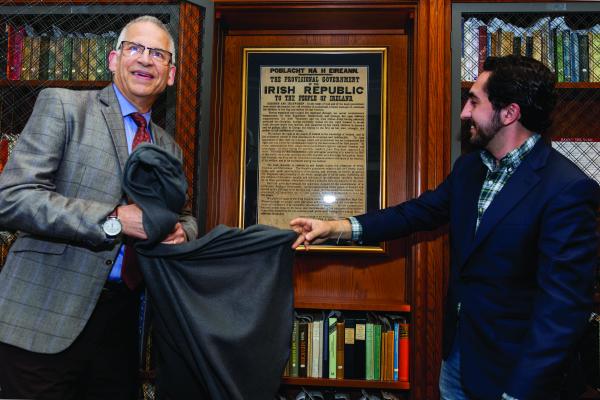
Burns Librarian Christian Dupont and Seamus Ruiz-Earle '20 unveiled the original copy of the 1916 Proclamation of the Irish Republic in the Irish Room of Burns Library on Sept. 30.
Boston College has announced the purchased a rare surviving example of an original 1916 Irish Proclamation, a foundational document in Irish history and the creation of the modern Irish state.
The Proclamation—one of perhaps 50 copies believed to have survived from the original printing of approximately 1,000—was obtained by BC’s John J. Burns Library and formally unveiled on Sept. 30 during a reception in the Burns Library Irish Room prior to a public lecture by Senia Pašeta, the Fall 2026 Burns Visiting Scholar in Irish Studies.
Burns Librarian and Associate University Librarian for Scholarly Resources Christian Dupont negotiated the purchase of the Proclamation, which had appeared at an auction in Ireland last fall, the university reported. The acquisition was made possible through the library’s gift fund, which is supported by the generosity of many donors.
The Proclamation was issued by the Irish Volunteers and the Irish Citizen Army on April 24, 1916, and read to the public outside the General Post Office in Dublin, marking the start of the “Easter Rising”—an attempted insurrection by Irish republicans against British rule in Ireland. Written by the Irish Republican Brotherhood Military Council, identifying itself as the “Provisional Government of the Irish Republic,” the Proclamation declared Ireland’s independence from Britain. It further stated that Ireland would be governed as a republic and guaranteed “religious and civil liberty, equal rights, and equal opportunity to all its citizens.”
In the short term, the Proclamation seemed irrelevant. The hoped-for uprising failed to attract support from most Irish citizens, and British forces, with an overpowering superiority in manpower, weaponry, and military experience and training, quashed the rebellion in six days. But the severity of the British response, and particularly its execution of the Easter Rising’s leaders—including Patrick Pearse and James Connolly, widely believed to have been the Proclamation’s chief co-authors—produced an upswell of support for the republicans’ cause among the Irish.
Almost three years after the Rising, the nationalist Sinn Féin party, which had won the recent general election to represent Ireland in the British Parliament, formed a unicameral parliament called the Dáil Éireann. In 1921, a treaty ended British rule in most of Ireland and led to creation of the Irish Free State, paving the way for Ireland to become a fully-fledged republic in 1949.
During the centenary celebration of the Easter Rising, Andrew Lynch of the Irish Independent called the Proclamation “1916’s greatest legacy, a radical and idealistic statement of the Rising’s principles that still inspires many people today.”
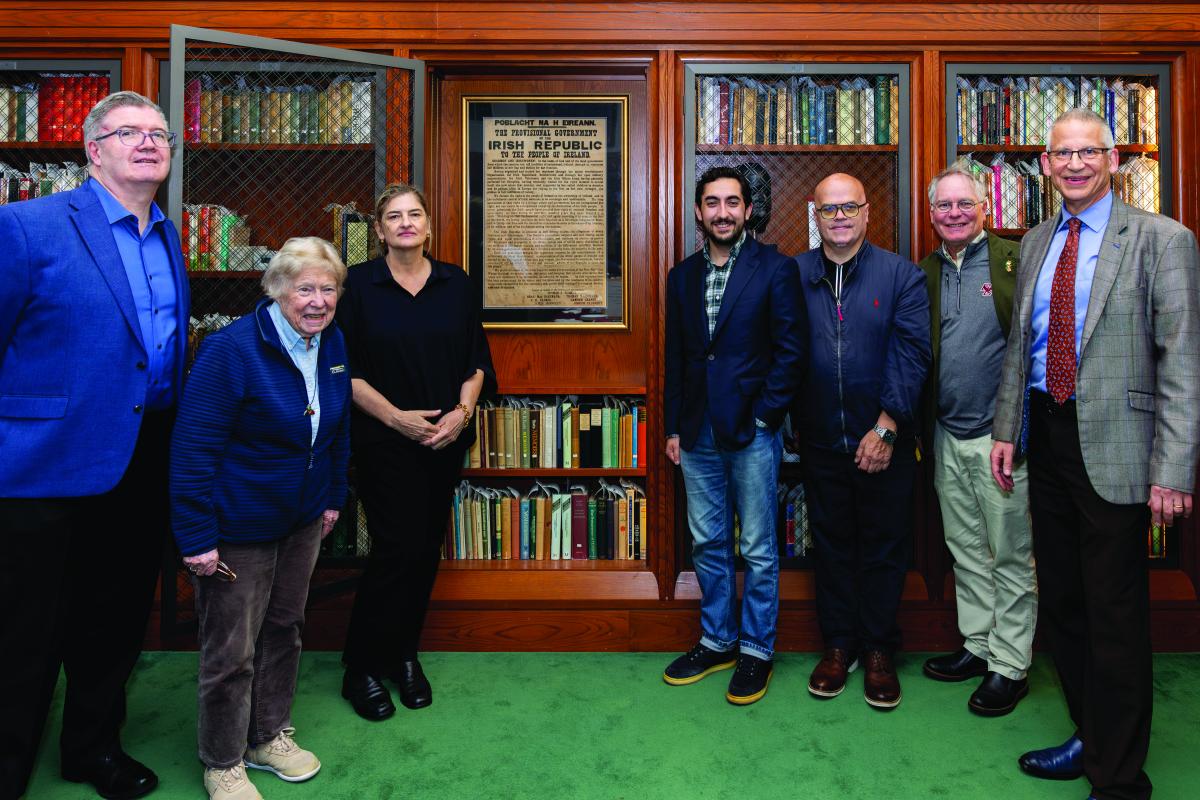
Among attendees at Boston College’s unveiling of the 1916 Irish Proclamation of the Irish Republic on Sept. 30 were, from left: BC Professor of English and Irish Studies James Smith; Catherine B. Shannon, former president of the Charitable Irish Society and Éire Society of Boston; Burns Visiting Scholar in Irish Studies Senia Pašeta; Seamus Ruiz-Earle '20, Carabiner Group founder and managing director, SBI, The Growth Advisory; Irish historian Erskine Childers IV; University Librarian Tom Wall; and Burns Librarian and Associate University Librarian for Scholarly Resources Christian Dupont
Said Sullivan Professor and Irish Studies director Guy Beiner: “It is of particular significance for Boston College’s Irish Studies program that the Burns Library has acquired a copy of the Proclamation of the Irish Republic, which is Ireland’s foundational national document. Although the 1916 Easter Rising was a failure in military terms, it ultimately launched a revolution which would lead to independence, and in this historic document the signatories—all of whom were executed—eloquently expressed the ideals which the state still aspires to fulfill.”
Dupont noted that the particular significance of the Proclamation obtained by BC stems from its provenance, one of only three known to have been preserved by women involved in the Rising. The Burns copy originally belonged to Helena Molony, a prominent Irish republican, feminist, labor activist, and colleague of James Connolly who fought in the Rising and later became the second woman president of the Irish Trade Union Congress.
She was charged with safeguarding and transporting the copies of the Proclamation from Liberty Hall, where it had been secretly printed during the night of April 23, 1916, to the General Post Office (GPO), where it was read the next morning by Pearse.
Molony gave a copy she had saved to socialist feminist and human rights campaigner May (Walsh) Keating, wife of the prominent painter Seán Keating. May Keating subsequently gifted it to Noel Browne, a physician, social reformer and Irish Minister for Health from 1948-1951. BC acquired the print by descent from Browne’s family through Fonsie Mealy Auctioneers, one of Ireland’s leading auction houses.
The Proclamation will remain on display in Burns Library’s Irish Room through the end of the fall semester. Members of the BC community and the public are invited to view it during Burns Library’s regular weekday hours. Call 617-552-3282 for more information.