
September 28, 2026
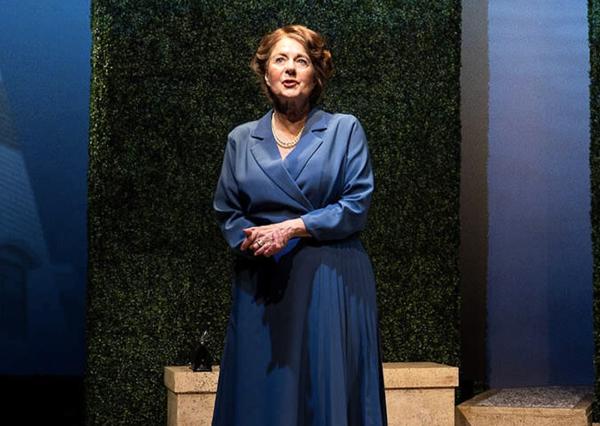
Paula Plum in “Eleanor”
Nile Scott Studio photo)
One of Boston’s most honored actresses is currently portraying one of the most prominent and consequential First Ladies in American history.
Paula Plum stars as Eleanor Roosevelt in the one-woman show, “Eleanor,” at Central Square Theatre. Written by Mark St. Germain and directed by Bryn Boice, the production plays through October 11.
In this intimate portrait of Mrs. Franklin Delano Roosevelt, audiences have a front row seat to her reflections on love, loss, politics and purpose, illuminating an enduring and lasting legacy of courage, empathy and service.
With President Roosevelt serving four terms from 1933 to 1945, Eleanor stands as America’s longest serving First Lady.
Born in 1884, and niece to President Theodore Roosevelt, she married Franklin in 1905. She gave birth to six children but would not limit her life exclusively to motherhood. A prominent political figure, she was a diplomat for the United States and an outspoken activist for human rights around the world.
It’s important to note that she was very politically aware, even as a young woman, before she and Franklin married.
While in the White House, she stated she would not appear as a “domestic ornament.” She held regular press conferences. She campaigned around the country. She wrote a monthly column for Woman’s Home Companion, and later penned a syndicated six-days-a-week newspaper column entitled My Day.
And ultimately, she helped save both her husband’s political career and his life when he was diagnosed with polio. That devotion was oddly contrasted with a series of sexual dalliances by each of them.
Following Franklin’s death, her work continued. Among her multiple triumphs, she chaired President Kennedy’s Presidential Committee on the Status of Women. She served as a US Delegate to the United Nations. And for many dozen years, she was voted one of the most esteemed women in the world.
When the play opens, Eleanor is in Rock Creek Cemetery outside of Washington D.C.
Although Eleanor passed in 1962, the time is now and Eleanor’s unsettled spirit is reflecting on a collage of her life choices.
Starring as Mrs. Roosevelt, award-winning Paula Plum continues to stand as one of Boston’s leading actresses. Over the past three decades, her most notable performances have included Cleopatra, Lady Macbeth, Beatrice and Phedre at the Actors’ Shakespeare Project; “Miss Witherspoon,” “The Heiress” and “Death of a Salesman” at Lyric Stage; “Body Awareness,” “The History Boys” and “New Century” at SpeakEasy Stage; and “Lysistrata,” “Ivanov,” “Mother Courage” and “The Marriage of Bette and Boo” at the ART.
She has been honored with the Elliot Norton Award for Sustained Excellence (past recipients include Sir Ian McKellen and Julie Harris) as well as the Norton for Best Actress twice.
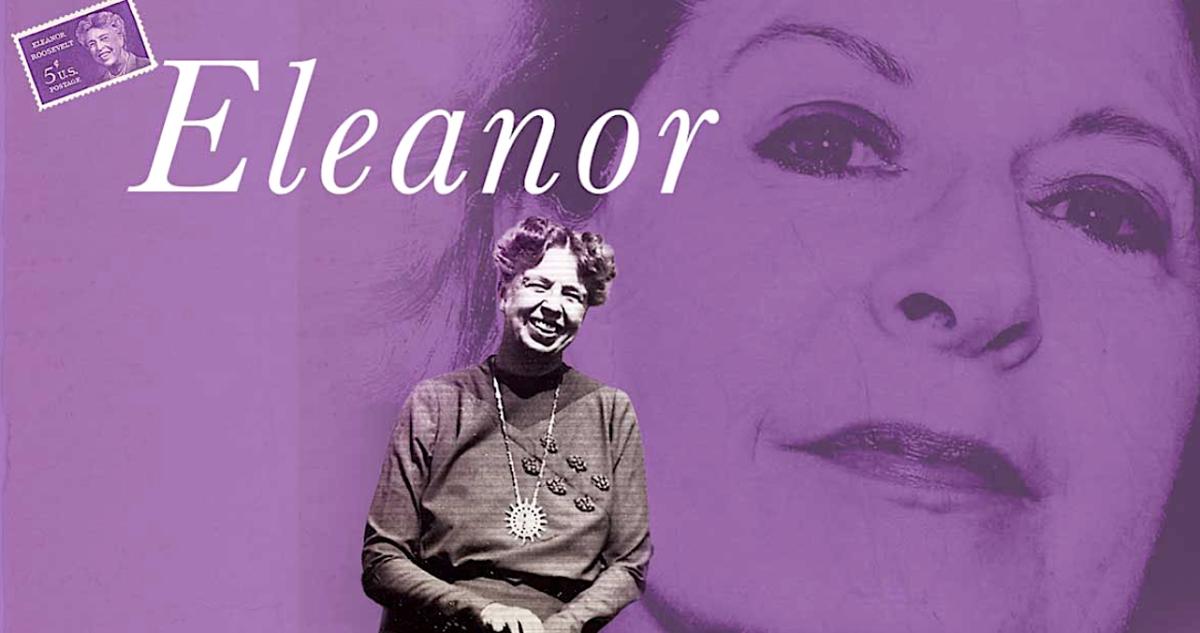
Paula Plum in “Eleanor”
Nile Scott Studios photo
I spoke recently with Paula about the show and her research on Mrs. Roosevelt. This is an edited and condensed look at our conversation.
Q. Were you very familiar with Eleanor’s life before accepting the role?
A. I’m ashamed to say not at all. I only knew of her through my grandmother who used to do an imitation of FDR (laughing.) I have to say I (took) a deep dive into the research. I went to Hyde Park, New York, to visit the FDR presential library. I did primary research on Eleanor. I read her diaries. I saw letters from her school days in England’s Allenswood Academy. I read her father’s copious letters to her. He wrote to her every day. It was incredible.
I went to Val-Kill, which was the cottage Franklin built for her three miles down the road so she could get away from the hectic life that they all led at Springwood, which was the mansion dominated by Sara, his mother. Val-Kill was where she formed a collaboration with three other women and they tried to create opportunities for the poor during the war to make things that they could sell.
Q. Was there anything that surprised you about her life?
A. Yes, the fact that she was bisexual. I don’t know if you’d call her a lesbian because she also had an affair with a man during the marriage. And I have to say we forgive her because it was after she discovered that Franklin was engaged, for a very long time, in an affair with Lucy Mercer (Eleanor’s social secretary), which Eleanor discovered in 1918. That’s at the very beginning of the play and that’s part of what she’s working through.
Q. With all her work and causes, she was also devoted to writing, wasn’t she?
A. The first book I read was “Empty Without You,” which is a collection of letters between Eleanor and (Associated Press journalist) Lorena Hickok. Very clearly, they had a strong physical and romantic relationship. So that surprised me. And after Lorena Hickok was out of the picture, she had, I believe, a physical relationship, at least a romance, with her bodyguard Earl Miller, whom Franklin had hired to protect her when she refused to be dogged by the Secret Service.
The letters are astonishing. She was a copious writer and kept a daily journal, by virtue of her column, My Day, a syndicated column that appeared all over the country – I think from her 30s all the way to her death in 1962.
Q. The volume of work she produced was impressive.
A. She wrote 400 words a day, six days a week. Just that alone is astonishing for a woman who was as busy as she was . . . Letter writing was something that everyone did constantly. You know, picking up the phone was available to them, but letters were the main form of communication. There’s so much documentation on her relationships with so many people. I went through many, many files with letters to foreign dignitaries. She was a good friend with Madame Chiang Kai-shek. She worked with Winston Churchill. There were relationships with the queen and the king of England.
She was the First Lady, but President Truman called her the First Lady of the World.
Q. For someone so outgoing, and at a time when women did not have this kind of influence, she didn’t have the easiest childhood. There was a great deal of tragedy and torment.
A. It started with her mother, who disparaged her from birth because she was a wrinkled and unattractive baby. And when she became a young child, like three or four, she was so serious all the time, her mother nicknamed her “Granny,” and that name stuck with her throughout her life.
She was terribly self-conscious, afraid to speak. She was very, very tall. At 15, she was already 5-foot-11. If you see her pictures from Allenswood School in England, she’s the tallest girl in the class. She was shamed for her looks because her mother was a renowned beauty, and so were all the women from her mother’s family . . . And she was tormented by her cousin Alice Roosevelt, who was a piece of work, Teddy Roosevelt’s daughter. They had a contemptuous relationship.
Q. Where did she find the strength and fortitude that defined her adult life?
A. I’ll tell you. She was sent by her mother at the age of 15 to Allenswood, run by a woman who was a well-known lesbian and political activist. Her name was Marie Souvestre. She educated her. There’s a great quote from her in the play. “You need to learn how to argue, how to stand up, how to take your own place in society and not the place society wishes to put you. Why do you think you were given a mind but to think things out for yourself.” So, she learned from Madame Souvestre how to be strong, how to speak her mind, how to have an opinion and how to have self-respect.
Madame Souvestre also took her clothes shopping because no one ever bothered to dress her very well. And so, in England she took her to all the most expensive shops, and woke up her sense of fashion. Although Eleanor was not a fashion plate, she had a very specific style throughout her life. Madame Souvestre taught her how to appreciate the tailoring . . . and nice lingerie (laughing).
Q. What do you think she’d say about today’s political division and lack of integrity.
A. I cry when I read her compassion, humanity, awareness, concern. Here’s just one little anecdote. Recently J D Vance’s son apparently has been taking the White House helicopters to golf lessons, which costs the taxpayers every single ride he takes.
The day Franklin died, Eleanor went back to the White House and met Mister Truman, who was then about to be sworn in as president, and asked him –-Franklin had died at Warm Springs, Georgia – if it was appropriate for her to take Air Force One or a military plane to Warm Springs now that she was no longer First Lady . . . Can you imagine?
Q. America’s First Ladies have a long tradition of standing along the sidelines, supporting their husbands but working on modest projects of their own. That was hardly the partnership Franklin and Eleanor forged.
A. Franklin was thinking about what the Americans were thinking, and what they needed during World War II. And he sent her out. He said “You’ve been my legs, Eleanor, now I need you to be my eyes and ears as well. She traveled everywhere. She went to mining camps. During WWII she went to the South Pacific to meet the troops and raise the morale. She was an incredible emissary.
Q. She was a liberated woman long before it was a popularized term. And the president openly relied on her strength and her invincible influence.
A. A World War I vet was quoted as saying. “Hoover sent the Army. Roosevelt sent his wife.”
“Eleanor,” Central Square Theater through Oct. 11, centralsquaretheater.org