
September 28, 2026
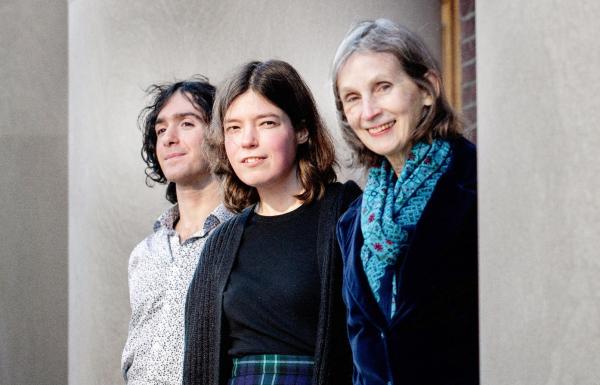
Isabel Oliart, flanked by Sammy Wetstein and Anne Hooper, formally launched their first album in September.
Boston-area fiddler Isabel Oliart is one of countless thousands who can trace their interest in Celtic music directly to the late Brian O’Donovan, and her connection was a special one: Her father, Antonio, a Grammy Award-winning recording engineer, worked not only on O’Donovan’s weekly “Celtic Sojourn” broadcast but on his annual “Christmas Celtic Sojourn” live show as well.
So, as a youngster, Oliart – who started playing classical violin at age three – went to “Christmas Celtic Sojourn” just about every year, and simply never got tired of it.
“The whole show was a dream to me,” she recalls. “I loved the way it would start slow and build up. I loved the stage with the Christmas scene and the stars, the songs, the poems Brian would read.”
And then, of course, there was the music and the musicians who played it, particularly the duo of Scottish fiddler Alasdair Fraser and cellist Natalie Haas.
“When I heard Alasdair and Natalie, something about the fiddle and cello sound caught my ear. The purity of the sound, the energetic drive and grooves of the chopping, combined with the melodies, harmonies, and arrangements the two of them created, were so compelling to me. They became my first big source of inspiration for fiddle music, and the first memories I ever had of hearing fiddle music live.”
Inspirational moments in childhood don’t always lead to sustained, life-changing experiences, but Oliart was motivated enough to expand her musical interests to Celtic traditions, especially that of Scotland, while maintaining her presence in classical. She made the rounds of sessions and camps, formed friendships (musical and otherwise), found mentors like Anne Hooper, Hanneke Cassel and Winifred Horan (of Solas), added her own tradition-inspired compositions to her repertoire, gave performances at venues including The Burren and Arts at the Armory, and three years ago, released her first album, “Late Evening’s Dram,” consisting mainly of original tunes.
Along the way, she picked up an endorsement from none other than O’Donovan himself, who described her work as “emotional, invitational, adventurous, and authentic.” He called Oliart “an excellent addition to an already thriving genre for vital and vibrant musicians, especially given that her training is from outside the genre.”
The past year or so has seen Oliart focus on her trio with Hooper and multi-instrumentalist Sammy Wetstein, culminating in a new album, “Tartan Rants and Rhapsodies.” The three formally celebrated its launch last month with concerts at Club Passim and City Winery Boston.
“Tartan Rants and Rhapsodies” includes a mix of traditional Scottish standards, such as “The Ewie wi’ the Crooked Horn” and the Johnny Wilmot reel “Hughie Shorty’s,” compositions by the immortal J. Scott Skinner, and originals by Oliart, Hooper, and Wetstein. Oliart and Hooper’s fiddles are complemented throughout by Wetstein on piano (bagpiper Jesse Ofgang guest stars on the opening track, a trio of Oliart tunes), displaying the various shades of power, grace, delicacy, and bonhomie found in the Scottish fiddle tradition. The set encompassing Hooper’s “Tartan Man/Kipling’s Rant/Hal Robison’s Rant” is a fine representation of these qualities, as is the trio’s take on Skinner’s outrageously intricate “The Mathematician” (which, as Oliart notes, allowed for her and Hooper to put their classical training to good use).
One of numerous delights for Oliart in recording “Tartan Tunes and Rhapsodies” was the opportunity to work closely with Hooper, who was key to Oliart’s development as a Scottish fiddler.
“Being both a classical and Celtic fiddle player herself, Anne understood how to be patient and encouraging with me as I adjusted to the style, while at the same time helping me fix the issues I was having. She could explain when and why I was playing in a more classical style and how to change it, without throwing me off completely. She helped me develop a very good sense of Scottish technique which greatly added to my appreciation of it, because that’s when I understood it the best. When I started to understand the style in that way I could start to learn how to fix some of those issues myself, and I got better really quickly.”
“Late Evening’s Dram,” by contrast, had an assortment of guest musicians, including Wetstein (on cello), Elizabeth Anderson Howe (fiddle), Conor Hearn (guitar), Elias Alexander (pipes), and Maeve Gilchrist (harp). The impetus came from working with Cassel, who had encouraged Oliart in writing her own tunes, and over a period of about three years she amassed enough so she felt ready to made an album.
“Having Katie McNally as the producer was really beneficial as she helped put all the tracks together, filling in any missing tunes with other tunes she found,” recalls Oliart, whose father served as recording engineer. “It’s not easy to record a CD and there are always bumps along the way, but the whole process went very smoothly, so although I needed to rest afterwards, I had a lot of confidence that I could do it again if I just followed that process of planning, recording, editing and mixing and mastering.
“What’s more, that album gave me a lot of confidence to be able to play with other musicians in more of a performance mode of arranged tunes. Some of those people I still play with today, and they have greatly enriched my musical life.”
“Tartan Tunes and Rhapsodies” was very much a “trio project,” says Oliart: Technically, they did not have a producer, although she tended to fill that role.
“It was also done over a longer period of time and in much different ways from my first album. While that made it slightly harder to navigate, I learned a lot more than I did from ‘Late Evening’s Dram,’ and that made it more rewarding, actually. And my bonds with Sammy and Anne have only deepened as a result as well. I’ll always treasure the experience of making this album together with them.”
Playing to a packed house at the album release concert in Club Passim last month also was a heartening experience for Oliart, who, along with Wetstein and Hooper, will be at the Gore Place Carriage House series in Waltham on Nov. 18.
“It really did mean a lot to me to be able to launch my new album at Club Passim. I have always wanted to perform there, and it was all the more worthwhile and special to have it be an album release. I was especially touched at having a full house of people from both the Celtic and classical communities, and by the many kind comments I got from people – and others wishing me well who couldn’t come to the show. The kindness of these musical communities is very special to me, and I truly loved playing for everyone that night.”
See isabeloliart.com for more information