
August 28, 2026
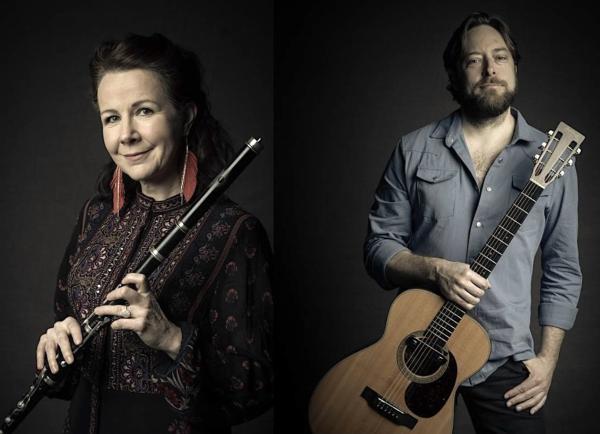
Nuala Kennedy and Alan Murray will be among the performers showcased at this year's Rockport Celtic Festival in the Shalin-Liu Performance Center.
Originally an end-of-summer event when it debuted in August of 2019, the Rockport Celtic Festival has since become a gateway-to-autumn affair, now held in early to mid-September. But this year’s festival, though it takes place September 10-13 at Rockport’s Shalin Liu Performance Center, is literally an event for all seasons.
Once again featuring a lineup of distinguished artists across the spectrum of Irish, Scottish, American, and other traditions and genres, the festival will include the premiere of a special suite of music celebrating the passages of the “Celtic Year”: samhain (winter), imbolc (spring), beltaine (summer) and lúnasa (autumn).
As in previous years, festivalgoers will have a choice of performances across the four days in large- and small-venue settings as well as opportunities to raise their voices in song and take part in social dances.
This year’s performers include Nuala Kennedy (flute, vocals), who will debut her commissioned piece “A Song for the Celtic Seasons: Samhain; Imbolc; Bealtaine; Lúnasa”; Fire & Grace, the duo of Edwin Huizinga (baroque violin) and William Coulter (guitar); chamber-grass quartet The Fretless, which will join with acclaimed Canadian indie singer-songwriter Madeline Roger for a special collaboration; Caoimhin O’Fearghail (uilleann pipes, flute, guitar, bouzouki, vocals; Alan Murray (guitar, bouzouki, vocals); bassist Logan Coale; and Latin accordionist, pianist and composer Sam Reider and the Human Hands, which explores the crossroads of folk, jazz, and traditional music.
Also on hand will be performers with ties to Boston and New England, including Lindsay O’Donovan (piano, vocals); chantey/maritime singer David Coffin; fiddler Oisín McAuley; multi-instrumentalist Seamus Egan; Copley Street, the trio of uilleann piper Joey Abarta, fiddler Nathan Gourley, and guitarist Owen Marshall; the Louise Bichan Band; and Oko, which comprises Charles Overton (harp), Emma Powell (violin) and Mina Kim (cello).
Masterminding the whole spectacle – as well as taking part in some of it – is Scottish harpist Maeve Gilchrist, who has served as the festival’s artistic director since its founding by the late Brian O’Donovan.
According to Gilchrist, the “four seasons” theme of the 2026 festival came about because of a series of fortunate coincidences. First was her choice of Kennedy as a performer: The Dundalk native (now based in Ennis) has brought her innovative approach to Irish and Scottish music on her five solo albums, as well as to a host of collaborations that include Eamon O’Leary in a duo, and with O’Leary and John Doyle as The Alt, and more recently as part of the revived Solas. Her 2023 album “Shorelines” grew out of her concept piece that centered on the presence of the sea in the lives of resilient women: how it separates and unites, brings tragedy and opportunity, and inspires both awe and dread.
“I thought about Rockport and the cycle of the year, where the city is situated in the natural beauty of the land and how it meets the sea and the salt marshes,” says Gilchrist. “That got me thinking about how prominently the seasons are displayed in beautiful landscapes like this. Nuala is a really gorgeous musician and a beautiful composer, and we talked about this as a rough theme.”
Around this time, Kennedy met up with Huizinga and Coulter, with whom she had collaborated a few years before, and they told her about their setting of Italian composer Antonio Vivaldi’s famous series of violin concertos, “The Four Seasons.”
“They explained how they distill the whole orchestra down into violin and guitar, and I just thought, ‘Wow, what an interesting thing to bring into our festival setting,’” she recalls, “We had this new commission by Nuala, a song cycle outlining the Celtic calendar, and I thought, ‘What if we had this Vivaldi set in the program as well?’
“From the start, Brian and I felt the festival should have a presence of chamber music in a space that was built for it. We saw the Rockport Celtic Festival as an opportunity to bring together the worlds of traditional music and classical music, to have classical performers showcase styles of music that were on the continent when Irish music and Irish harping was in its heyday.”
“On the Ocean’s Edge,” the climactic festival event, will feature Kennedy performing “A Song for Celtic Seasons” with what Gilchrist calls “an all-star house band.” In addition, Gilchrist will team up with Egan to present “Into the Ice,” a retelling of the famous Ernest Shackleton expedition to Antarctica through music and spoken word, while Fire & Grace offer their Vivaldi adaptation, and Coffin teams with Oko.
But, as Gilchrist points out, “that’s the last event of the festival – there’s so much more that happens before it.”
The Fretless have the stage to themselves at the “Celtic Club,” a kind of festival appetizer which takes place Sept. 10 in the Shalin Liu’s third floor reception hall, which provides a more intimate space. Opening night on Sept. 11 will feature a diversity of sounds and styles: songs and tunes from Kennedy and Murray; pure-drop Irish trad from McAuley and O’Fearghail; Bichan, a fiddler from Orkney who along with her band will offer up music with a transatlantic dimension; and Reider and the Human Hands with their own idiosyncratic specialty.
The following day begins with not only music but conversation: a “Salon Session” hosted by Gilchrist at which The Fretless and Huizinga and Coulter will discuss their creative processes and the way they go about bringing inspiration to life. Meanwhile, at nearby First Congregational Church, Coffin will lead one of his ever-popular chantey sings, where audience participation is enthusiastically welcomed.
That evening’s centerpiece trains a spotlight on the versatility of stringed instruments across genres. “A Season of Strings” will include The Fretless with guest star Rogers, Fire & Grace, and Copley Street, with Gilchrist adding poetry and storytelling to her harp performance.
Later that evening is the “Celtic Ceilidh,” and an opportunity for festival attendees to learn social dances from Celtic traditions, with a live band providing music and no small amount of inspiration.
“We're always thinking about how to bring in younger generations, how to be more of an additive festival, something that give backs a little bit to the community,” says Gilchrist. “So, we’ll have The Fretless working with some local schools earlier in the week, talking with kids about music. We encourage them to come get involved, especially at the ceilidh, where they can participate and see how music is a way to share joy.”
Always an integral part of the festival, the spoken word is fully in the limelight during Sunday’s “Words and Music: The Celtic Spirit,” with O’Donovan, Coffin, Egan, and Huizinga plus special guests presenting poetry, prose, storytelling, and tales of the imagination set against various musical backing.
“This is always my favorite event at the festival,” notes Gilchrist. “Brian used to call this ‘going to church’ – it’s an opportunity for contemplation, for just being still and reflective, something that we all can benefit from these days.”
All of which leads to “On the Ocean’s Edge,” and the climax of the 2026 festival – and, for Gilchrist, the official start of planning for the 2027 edition.
“When I try to come up with ideas for the festival, I think about concerts and other events I’ve seen that involve imaginative planning and programming,” she says. “But you know, it’s really the musicians themselves who make it all happen. Once I get the key artists involved, it's a conversation of ‘Would you be interested in doing this? What does this make you think of? Can you think of symbiotic or complementary poetry or other acts that might be a good fit?’
“I'm trying to balance traditional music and contemporary offerings stemming from the Celtic isles and a presence of chamber and classical music, soundscape, the sea. It's all so connected to me. Ideally, the Rockport Celtic Festival can just become this sonic environment that the audience trusts to step into and be satisfied in a number of ways: music, song, words, contemplation.”