
September 24, 2026
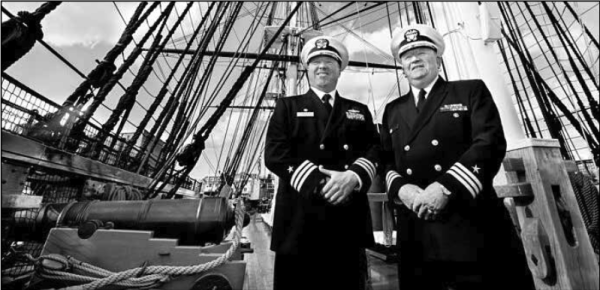
Commander Bob Gillen, Sr. (right) on the USS Constitution was photographed by Bill Brett for his book, ‘Boston Irish.’
The Charlestown neighborhood in 1950s Boston featured so many Irish American families from Donegal with the same last name that residents resorted to nicknames to differentiate between the many McLaughlins and Dohertys. But there were three brothers in one family who didn’t need nicknames: The Gillen boys made names for themselves.
George (aka “Brother”), Bob, and Maurice (“Moe”) all left St. Mary’s School and parish and found high achievement that was grounded in their Irish American values, and a shared commitment to helping others.
“We were the old European traditional family where one went to the church, one went to the military and one stayed home,” says Moe, now 87 and the lone remaining brother. “We were not encouraged to be followers. We had our own Irish-Catholic values. We also had the stubbornness of the Irish.
“We each in our own right exhibited different kinds of leadership. The three Gillen boys always moved ahead, and they didn’t wait to see who was behind them…I’m not saying we were always right but we were always ready to fight.”
Posthumous accolades continue to fall on the family. George, who died in 2017, became a Catholic missionary, taking the name Brother Francis Joseph. He is in early consideration for canonization by the Catholic Church for his deeply committed work over 71 years with the poor in the Philippines.
The late US Navy Commander Bob Gillen, Sr.’s decorated career including working in crypto communications decoding secure messages as a member of an elite security group and his posting as the 59th Commander of the USS Constitution. His service continues to shine eight years after his passing. He was honored last week (Sept. 9) in the Charlestown Navy Yard with a play boat named in his honor for kids on the HarborWalk.
And the ever-busy Moe remains highly connected in Charlestown and Boston politically and civically.
Bob Gillen Jr., a retired US Navy Commander with his own impressive resume, says his dad and his two uncles were remarkable for how they applied their Irish American values in the interest of others.
“Each one of them had a passion, and obviously the oldest brother chose the church, the middle brother chose the military, and Moe chose civic duties,” he said. “Each was deeply involved in all of it. So, all three brothers somehow instantiated into them this ethos of wanting to live a life of service, and each one of them did it in his own particular fashion. And I think the ‘Town’ gave my father that background and the Navy gave him the canvas to paint things on.”
With immigrant grandparents from Donegal and Cork, the brothers were indoctrinated into politics and community early on. George and Mary Gillen were close with prominent politicians like the former mayor of Boston, governor of Massachusetts, and US Labor Secretary Maurice Tobin.
Moe recalls his father, a City of Boston employee, was a “kind of advance man” for political people, but “more of a tough guy.” Steeped in community activism and political aura, he and his associates used their access to help others whenever possible. That never changed, but family prospects did when their George Sr. died at age 47 when Moe was in grammar school and the other two sons had recently set off on their own pursuits in the church and the military.
“It was tough to go from the top to the bottom so fast” in terms of influence, says Moe, who as a kid caddied at Hatherly Golf Club in Scituate for Tobin and James Michael Curley.
“All of that clout pretty much disappeared,” he notes, “but my mother impressed upon us to help others, and we were obligated to do something.”
It wasn’t long before they found their footing in Charlestown, and around the world.
The Missionary
Brother Francis – known in the family as “Brother’ - was the quiet one, who, Moe and his older sister, Irene Moffat, say, was born to serve others. He did so as a member of the Hospitaller Order of St. John of God in a remote part of the Philippines for seven full decades, serving the sick and indigent in a psychiatric hospital that he founded – the Hospicio de San Juan de Dios in Bulacan, Philippines.
Moffat was closest to him, but she still was surprised to learn this summer that the Brothers of Mercy were seeking testimony to support his potential cause for canonization, i.e., sainthood, in the Catholic Church.
“They’re investigating for canonization. Can you believe it?” she said during the ceremony for her brother Robert, on Sept. 9. “Oh God, they were awful growing up, though. They were aggravators, boys aggravating the girls. But Brother Francis and I were close. We all thought he was a saint anyway and the brothers in the Philippines did, too.”
She recalled how she and Brother would tease their older sister, Barbara, early on Saturday mornings in the home. “He played the piano, and the piano was up against the wall of my sister’s bedroom,” she recalled. “I’d say to Brother on a Saturday morning, ‘Brother, play Glow Worm.’ If you know that song, then you know why my sister would come out screaming, ‘Mom!’”
Moe recalls how at age 12, Brother collected unused medications from family physicians in Charlestown, and gave them to the Little Sisters of the Poor convent to use with indigent patients at their hospital in Somerville.
So, it wasn’t a surprise when, at 16 and only a sophomore, Brother Gillen left the former Commerce High School in the Fenway to join the church – eventually leaving for Rome and then the Philippines and rarely coming back. He was so devoted to the poor that he refused to take a vacation. His last visit to Boston was in 1988.
“Brother never took off the collar,” recalls Moe, who was often his driver. “He was always a brother and always doing God’s work even when they forced him to take a vacation. He never took a vacation from his vows.”
The Commander
Bob Gillen, Sr. grew up hanging out at the Monument in Charlestown “pointing tourists in the right direction” – giving them “information” – in exchange for coins. He was known as a great talker, a charmer, but also the tough one of the family – a hockey player who was a fine skater and attended English High School. With service embedded in his character, and military service on his mind, he left high school in February of his senior year to join the Navy.
“We grew up on a battlefield in Charlestown and it was drilled into us support for service of country and what sacrifice meant,” says Moe. “The first veterans and KIAs of the American army were under our feet at Bunker Hill.”
Bob, Jr., said his father was unique in his abilities from a young age. “Each one of the brothers had the background of their father and how things had worked in Charlestown and in Massachusetts,” he said. “When my father looked at it, I think he wanted to see if he could do something on his own.
“He went in the Navy and he was tested and because of his brain, he was able to test into a very elite part of the Navy security group using codes and ciphers. Then ultimately being selected as special duty crypto officer, and on up through the ranks he went.”
During his time in the Navy, Bob Sr.’s Irish roots came into the picture, eventually producing the love of his life, his wife “Paula,” during a visit to Dublin. She lived right next to the Guinness factory, where her father worked.
“That’s probably what drew him to Ireland - to go look for the roots, and then he met my mother,” says his daughter, Eileen Dannemiller. “He met her in Ireland, so he had to keep enlisting to keep going back until she would marry him. After six years, he finally convinced her to marry him, and we were all over the world growing up in the Navy.”
After an elite career, Commander Gillen had that final posting – Charlestown, and the USS Constitution’s 59th leader. He didn’t just take the position; he revolutionized it, organizing “Old Ironsides” as a functioning ship that sailed out into the Harbor. In 1980, he was at the helm when, for the first time, it led a historic parade of ‘Tall Ships’ into Boston Harbor.
“He immediately took the things that the Navy has, and he said, ‘Look, the Constitution’s a regular ship. It needs the power of a ship,’” said Gillen, Jr. “He pulled back from administrative duties, and he empowered the ship. He helped the Constitution do things that it could never do.”
In his retirement, Bob Sr. was the leader of the Junior Reserve Officer Training Corps (JROTC) program at the former West Roxbury High School, where thousands of kids from all over Boston would come to know and respect him.
“Bob had to learn to keep his mouth shut because he got sensitive information even before the big shots,” said Moe. “Brother was a simple, quiet man who did God’s work. Two of the three brothers learned to keep their mouths shut but the baby brother, Moe, didn’t quite get that lesson – although I can keep my mouth shut sometimes.” He smiled, then laughed.
The ‘Simple Meter Reader’
The Gillen kitchen table on St. Martin Street in Charlestown is a familiar gathering place for many politicians, family members, friends, and a host of “troublemakers,” as Moe noted. He recalled that the kitchen setting was where Irish families in Charlestown sorted out life. “We’d sit there and settle whatever world crisis, and everyone got their say,” he said.
Earlier this month, while eating potato salad and wearing a shirt reading, ‘Charlestown – God’s Country,’ that bore a Celtic cross flanked by American and Irish flags, he thumbed through text messages from Mayor Michelle Wu, state Sen. Lydia Edwards, members of the Lions Club, residents looking for help, and an email with unsolicited advice to Republican gubernatorial candidate Mike Minogue.
“Moe has always been known for his sense of humor,” said Moffat. “Everyone knows him in Charlestown and if they need something, they’ll call him. He’s actually named after Maurice Tobin, but nobody knows that.”
As the baby of the family, Moe stayed home and built a blue-collar career with Boston Gas while raising a family and remaining fully in the soup when it came to current affairs. Gifted with an edgy humor and wit, he was a prominent activist in the 1970s busing era –he still refers to it as “forced busing” – trying to mediate between the sides and working behind the scenes to advance the Charlestown agenda of keeping Charlestown kids in Charlestown schools using the US Constitution as a basis for his argument.
“Our grandparents came from a depressed area in an oppressed country,” he says. “It was impressed on us in the ‘Town’ how important it was that we lived in a country with so much freedom and we cherished that freedom. That’s one reason we fought forced busing, but we fought it within the frameworks of the Constitution. We had our own rights and we were going to exercise them.”
Well before that, though, Moe had been an advance man like his father, but without the “tough guy” aspect. He remains so today – an unlikely political operative from a blue-collar background dealing with highly placed and formally educated people with his only pedigree item being a Charlestown High School diploma.
Often, when things would happen behind the scenes and Moe was the suspected antagonist, his response was, “I’m just a simple meter reader.”
The name stuck among his friends and family.
“No one ever saw my hand at work,” he explained. “What ‘simple meter reader’ says is I give credence to the blue collar guy like me; that we can think for ourselves and don’t have to depend on these alleged experts. We are quite capable of running a family and having good social values.”
Moe remains adept at picking a winner and finding political allies to advance his ability to help others in Charlestown and beyond. One of those unlikely allies was state Sen. Jarret Barrios – an openly gay legislator from Cambridge who represented Charlestown from 2003 to 2007. Moe not only supported him, but he also took a position on his staff – far from Barrios in political thought, but close to him in service.
For Moe Gillen, that dichotomy shows that the world is just one big kitchen table, where anyone is welcome to sit and hash things out – no matter what their opinions might be. And particularly if the result is the common goal central to the Gillen brothers: supporting those in need.
“When I worked for Barrios, helping people wasn’t a learned skill because I had that going in and we helped all sorts of people,” he said.
“If nothing else,” he added, “the three Gillen boys had the ability to work with people on common issues, even if they disagreed with them, and at the same time, respect people for who they are regardless of their political views.”