
May 21, 2026
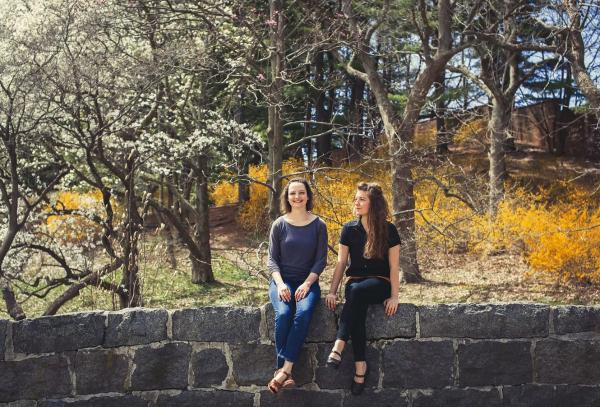
For years, Boston-area Irish dance performers and teachers Jackie O’Riley and Rebecca McGowan have thought long and hard about what they do, how they do it, and what it all means – and have turned that musing into artistic expression.
In 2019, they released “From the Floor,” a compendium of six separate but associated videos that served as a visual album of Irish music and dance. Filmed in the Victorian house owned by McGowan’s grandmother, “From the Floor” depicted the holistic event of dance – not just the act, but the anticipation of it, the effect and influence of setting, and the chemistry between dancers and musicians (in this case, accordionist Chris Stevens and fiddler Nathan Gourley).
Now, the pair are set to debut their new endeavor, “When the Music Starts, I’ll Know,” on May 30 and 31 at The Loov in Somerville [www.theloov.studio/]. A live performance event as well as an oral history project, “When the Music Starts” explores in depth the impact and influence of dance on one’s life – in this case as a calling. It is based on interviews McGowan and O’Riley conducted with 13 women ranging in age from their 30s to 70s who have long performed and taught dance, including Irish and Cape Breton traditions but also genres like jazz, contemporary and disco.
“When we began this project, we wanted to know about the paths dancers forge to sustain a lifelong practice,” O’Riley and McGowan write in their introduction to “When the Music Starts.” “How do artists who are community builders also nurture their creative work? What does it mean to rely on your body as your mode of expression? How is identity tied to artistic practice over the course of a lifetime?
“These interviews, at times funny, poignant, and thoughtful, are full of the sustaining power of a creative calling. It was a real pleasure to simply spend time in conversation. We found ourselves drawn to the stories and anecdotes that underscored how dance is intrinsically woven into identity and belonging. Between the lines, we heard echoes of quiet moments of sacrifice, and the gift of finding sanctuary. There is a geography of dance in each person’s life and a sense that movement and music are essential in their experiences.”
The live events will feature performances by four of the interviewees: Cait Bracken, longtime set dancing instructor at the Irish Cultural Centre of Greater Boston; Maureen Doyle, who performed as a step dancer as a child and young woman, then resumed decades later in partnership with her brother Kevin, a well-known dancer himself; Alanna Callendrello, an active member and teacher in the New England and Irish ceili scenes; and Aubrey Atwater, a musician and singer as well as a dancer in Celtic and American traditions who also performs with her husband Elwood Donnelly.
Providing music will be pianist Neil Pearlman and fiddler Laura Fedderson. Pearlman – also the project’s music director – has been part of numerous collaborations that feature his unique amalgam of Canadian Maritime, New England and Scottish styles, along with elements of jazz, classical and other genres. Fedderson has been a mainstay of Boston’s Irish music scene for more than a decade, but she also has a strong background in American traditional music; she’s played in a duo with fiddler Nathan Gourley and as part of the bands Ship in the Clouds and Wooden Nickels.
The show also will feature “audio collages” with snippets from interviews with the dancers, Pearlman providing live piano accompaniment.
The “When the Music Starts” project was created in part through a Live Arts Boston grant from the Boston Foundation and a grant from Cambridge Arts, a local agency supported by the Massachusetts Cultural Council.
The questions that served as the basis for “When the Music Starts” are to some extent universal, pertaining to most any life endeavor: How does one sustain a lifelong practice? What changes over decades, and what remains essential? How does identity evolve alongside creative work and community involvement?
But dance has its own distinctive demands and challenges – certainly the physical part, which is always a consideration for those who devote significant time to it. Finding or creating a space in which to practice or teach, or perhaps to work on performance ideas, is another. But just as importantly, dancers seek connection with other artists.
“These are questions that Rebecca and I have been thinking and talking about for years,” says O’Riley. “We wanted to get to the heart of what it means to be a dancer, to be part of a community, and how sustainable this career is. How can you help to build and maintain that community and have the time and space to nourish your creative side?”
The interviewees don’t share the same exact experiences or circumstances, notes McGowan. While some have devoted themselves full-time to dance, for example, others have had to make room for it alongside careers or raising families, or both. So the question “How does your identity as a dancer change as you age?” made for some fascinating, and poignant, answers.
“It was interesting to hear from the older generations, who were less likely to have pursued dance professionally,” says O’Riley. “They might not have said it directly, but there was a hint of paths not taken and missed opportunities, even though they were certainly glad to have been involved in dance. For them, their identity as a dancer perhaps means something different than for other generations.”
Folk dance traditions – such as those of Ireland and Cape Breton – not only serve a social function but have a special relevance as a link to the history and culture of their respective communities, especially those that have taken root in other countries, say McGowan and O’Riley. Those who teach and lead these dances at gatherings, besides contributing to the fun, feel they are fulfilling an important task by helping others affirm their shared bonds.
“There’s a sense of dance being part of one’s identity and, simultaneously, being tied into that larger community — a feeling of belonging,” says McGowan.
“Many communities rooted in tradition are shaped by strong social and intergenerational ties,” adds O’Riley. “This relates to another theme that we heard in our interviews: sanctuary. For some, dance has been a lifeline through hard times, a means to reorient and center themselves.”
Then there is the simple joy that comes from realizing dance was what you were supposed to do all along, as was the case with Colleen O’Connor Tomas. She didn’t start until adulthood in the early 1970s, but found herself enjoying disco so much she made it her vocation, enough to become a teacher, then a New England Patriots cheerleader, and now a fitness professional.
“You can tell Colleen is a dancer by the way she carries herself,” says O’Riley. “She was always reaching, always striving, and dance became a central part of who she is.”
The website for “When the Music Starts, I’ll Know” is at https://www.fromthefloordance.com/when-the-music-starts-show. More content will be added following the May 30 and 31 performances.